
Bituminous Waterproofing Membrane Against Water Infiltration
The ANELTEC bituminous membrane is a high-performance waterproofing and insulating membrane, bitumen-based, available in sheets or rolls.
The bituminous membrane is mainly used as protection against water infiltration.
It is a material commonly used in construction and industry to create reliable and long-lasting waterproofing systems. It is mainly composed of bitumen, a viscous substance derived from petroleum, mixed with polymers, fiberglass, or felt. This combination of materials gives the bituminous membrane a range of advantageous characteristics.
First of all, the bituminous membrane is renowned for its water resistance. It is used to seal and prevent water infiltration in foundations, walkable surfaces, and roofs (both new constructions and renovations), as well as other structural elements. Its ability to adapt to shapes and create a watertight seal makes it ideal for areas subject to heavy rainfall or flooding.
In addition, the bituminous membrane is valued for its long-term durability. It is resistant to weathering, wear, and corrosion, which means it requires minimal maintenance over the years. This makes it a cost-effective long-term solution for protecting building structures.
Applications of the ANELTEC bituminous membrane:
The product offers excellent resistance to weathering and to tensile stress/deformation, characteristics that make it a particularly reliable waterproofing membrane.
The bituminous membrane is a product used to create continuous-type waterproofing systems, so called because the individual rolls are heat-welded together, forming a continuous layer.
The membrane is usually applied using a flame and is mainly used for flat or slightly sloped roofs, but it can also be applied on inclined surfaces.
- Waterproofing of flat or slightly sloped roofs
- Waterproofing of pitched roofs
- Protection against water infiltration on terraces and roofs of buildings or industrial warehouses

Installation of the bituminous membrane:
The bituminous membrane can be installed either cold-applied or hot-applied, although hot application is the most commonly used method.
Cold application of the bituminous membrane involves the use of a bituminous adhesive applied with a roller or trowel. Hot application involves the use of an open flame: installation begins by heating the roll with a torch. The membrane can be bonded to the substrate in three different ways: full adhesion, by heating both the membrane and the substrate; semi-independence, using specific membranes; or independence, by flame-bonding only the overlaps. In this case, the membrane must always be weighted down with gravel or soil.
The ANELTEC bituminous membrane is available in different types, with varying levels of cold flexibility performance. Roll dimensions are 1 m × 10 m, for a total of 10 m² per roll.
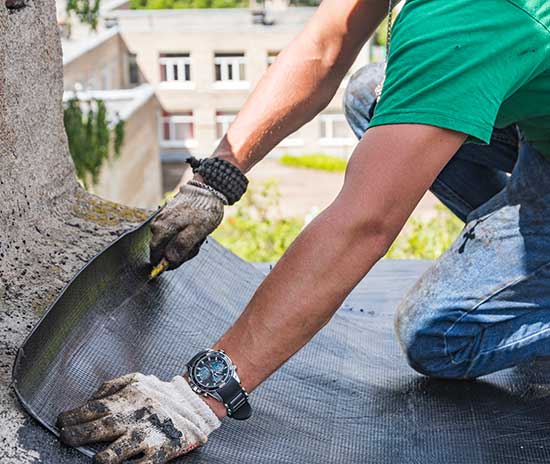
In the construction sector, flat roofs are often covered with layers of bituminous membrane, which can be installed in multiple layers to increase effectiveness in thermal insulation and energy efficiency of buildings. This type of application also contributes to reducing heating and cooling costs.
The bituminous membrane is highly adaptable and can be easily repaired or replaced if damaged, without the need for significant renovation work. This flexibility is particularly valuable in the construction industry, where changes and repairs may be required over time.
In conclusion, the bituminous membrane is a reliable and versatile material that plays a crucial role in the construction industry and in many other applications. Its ability to provide waterproofing, thermal insulation, and long-term durability makes it an essential component for the construction and maintenance of safe and efficient buildings.